

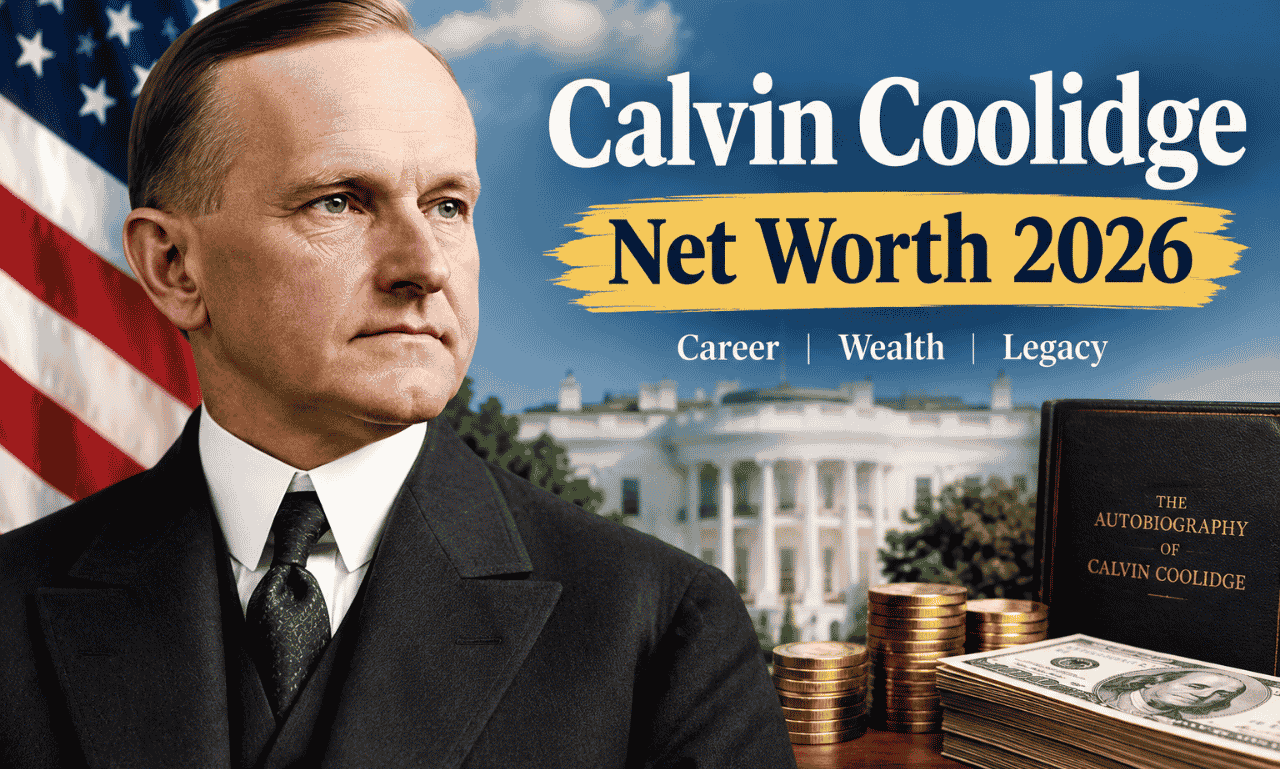
Calvin Coolidge net worth is generally estimated at around $500,000 to under $1 million in modern-dollar estimates. However, there is no universally accepted audited figure for his lifetime peak wealth. Historical presidential wealth rankings use different methodologies, particularly when converting early-20th-century assets and income into today’s dollars.
Coolidge’s financial story is particularly interesting because he did not enter the White House as a wealthy businessman or heir. When he became president in 1923 after the death of Warren G. Harding, his reported net worth was approximately $10,000. The Calvin Coolidge Presidential Foundation notes that this was equivalent to roughly $125,000 using its cited inflation calculation.
That makes Coolidge very different from some of the wealthiest presidents in American history. George Washington accumulated substantial wealth through land and plantation ownership, while Herbert Hoover became wealthy through his international mining career. Coolidge, by contrast, built his finances through a combination of law, public service, presidential salary, savings, property and writing.
His wealth increased during and after his presidency, but he never became one of America’s richest presidents.
Understanding that distinction is essential when researching Calvin Coolidge’s financial legacy.
Quick Facts About Calvin Coolidge
| Fact | Details |
| Full Name | John Calvin Coolidge |
| Born | July 4, 1872 |
| Died | January 5, 1933 |
| Age at Death | 60 |
| Nationality | American |
| Profession | Lawyer, Politician, Author |
| Political Party | Republican |
| Presidency | 1923–1929 |
| Estimated Net Worth | Approximately $500,000 to under $1 million in modern estimates |
| Estimated Wealth in 1923 | About $10,000 |
| Presidential Salary | $75,000 per year |
| Spouse | Grace Coolidge |
| Children | John Coolidge and Calvin Coolidge Jr. |
| Known As | Silent Cal |
| Presidential Number | 30th President of the United States |
You must be read: David Thewlis Net Worth: Powerful Career & Wealth in 2026
Calvin Coolidge Net Worth and Wealth Explained
Calvin Coolidge was born into a relatively modest Vermont family and spent much of his early adult life establishing himself professionally before entering national politics.
After graduating from Amherst College in 1895, Coolidge studied law and was admitted to the Massachusetts bar in 1897. He opened his own law practice in Northampton in 1898.
His legal career gave him an independent income, but politics eventually became the dominant part of his professional life.
Coolidge served in several positions in Massachusetts before reaching Washington. He was a city councilman, city solicitor, mayor, state representative, state senator, president of the Massachusetts Senate, lieutenant governor and governor.
His national career began when he became vice president under Warren G. Harding in 1921.
In August 1923, Harding died unexpectedly, making Coolidge president.
At that point, Coolidge’s finances were still modest. The fact that he reportedly had only about $10,000 in wealth when entering the presidency is one of the most useful pieces of information for understanding his financial trajectory.
During his presidency, he earned the official presidential salary, accumulated savings and benefited from the increased earning potential that came with national fame.
After leaving the White House in 1929, his reputation became an additional source of income. He wrote articles, published his autobiography and produced syndicated newspaper material.
He also joined the board of New York Life Insurance Company.
His later-life finances therefore combined traditional assets with income generated from his public reputation.
How Did Calvin Coolidge Make His Money?
Unlike modern celebrities whose fortunes may come from entertainment contracts, sponsorships and social media, Coolidge’s income came from traditional professional and political sources.
1. Legal Career
Law was the foundation of Coolidge’s personal finances.
After completing his education at Amherst College, Coolidge studied law through an apprenticeship in Northampton rather than attending a modern law school.
He was admitted to the Massachusetts bar in 1897 and established his own law office in 1898.
His clients included businesses and financial institutions. Although he did not become a nationally famous attorney, the practice gave him a stable professional income.
This period is important because it shows that Coolidge had already established a career before politics became his primary occupation.
His legal work also gave him knowledge of business and finance that proved useful during his political career.
2. Government Salaries
Coolidge spent decades in public office.
His political positions included mayor of Northampton, Massachusetts state senator, lieutenant governor and governor.
Each position provided a salary, but none made him extraordinarily wealthy.
His largest government income came from the White House.
When Coolidge became president, the presidential salary was $75,000 annually.
That salary had been established by Congress in 1909 and remained unchanged until 1949.
For the 1920s, $75,000 was an extremely substantial income. Nevertheless, Coolidge’s financial position should not be compared directly with modern presidents or celebrities because the purchasing power and economic environment were very different.
His presidential compensation provided a dependable foundation for increasing household savings and financial security.
3. Writing Income
Writing became particularly important after Coolidge left office.
His political reputation made him an attractive contributor to newspapers and magazines.
In 1929, TIME reported that Coolidge received at least $10,000 for an article concerning his experience entering and leaving the presidency.
He also wrote a syndicated newspaper column called “Calvin Coolidge Says.”
In addition, he published The Autobiography of Calvin Coolidge in 1929.
These activities provided income at a time when former presidents had fewer opportunities than they do today.
There were no presidential speaking circuits comparable to those available to former presidents in the 21st century, so writing and publishing were especially valuable ways for Coolidge to monetize his reputation.
4. New York Life
Coolidge also developed connections with the private sector after leaving Washington.
In 1929, he became a director of New York Life Insurance Company.
The appointment demonstrated that his reputation remained valuable after his presidency.
However, it would be misleading to portray Coolidge as a major corporate entrepreneur. His New York Life role was one component of his post-presidential financial life rather than the source of a vast fortune.
5. Real Estate
Real estate represented another important part of Coolidge’s later financial position.
For much of his political career, Coolidge did not own a home.
The Coolidge family rented a residence in Northampton before eventually purchasing The Beeches, their Northampton home after he left the presidency.
The property became closely associated with the former president and was his home during the final years of his life.
Property values, savings and other assets help explain why modern estimates of Coolidge’s wealth can be considerably higher than his reported $10,000 position when he became president.
Early Life and Education
John Calvin Coolidge was born on July 4, 1872, in Plymouth Notch, Vermont.
His birthday was historically unusual because he remains the only U.S. president born on Independence Day.
Coolidge grew up in a rural environment. His father, John Calvin Coolidge Sr., was a storekeeper and farmer who was also involved in local public affairs.
The young Coolidge attended Black River Academy before enrolling at Amherst College in Massachusetts.
He graduated from Amherst in 1895.
His education at Amherst became an important part of his intellectual development. Coolidge later became known for a reserved and disciplined personality, qualities that were often associated with the New England environment in which he was raised.
After college, he moved toward a legal career.
Instead of attending a traditional law school, he studied under practicing attorneys. This approach reflected the legal education system of the period.
He was admitted to the Massachusetts bar in 1897.
The following year, he opened his own practice in Northampton.
This legal background was the first major building block in his eventual financial independence.
Calvin Coolidge Career Timeline
1895 – Graduates From Amherst College
Coolidge completed his education at Amherst College.
1897 – Admitted to the Massachusetts Bar
After studying law through an apprenticeship, Coolidge became a licensed attorney.
1898 – Opens Law Office
He established his own legal practice in Northampton, Massachusetts.
1899–1915 – Enters Local and State Politics
Coolidge began his political career in Northampton and later entered the Massachusetts legislature.
1916 – Becomes President of the Massachusetts Senate
His growing reputation within the Republican Party helped establish him as an important state political figure.
1919 – Boston Police Strike
As governor of Massachusetts, Coolidge became nationally recognized for his response to the Boston Police Strike.
His statement that there was “no right to strike against the public safety by anybody, anywhere, anytime” became one of the defining moments of his political career.
1921 – Becomes Vice President
Coolidge was elected vice president alongside Warren G. Harding.
1923 – Becomes President
Following Harding’s death, Coolidge became the 30th president of the United States.
His father administered the presidential oath in Vermont.
1924 – Wins Presidential Election
Coolidge won the 1924 presidential election and secured a full term in his own right.
1929 – Leaves the White House
He declined to seek another term and left office in March 1929.
1929–1933 – Writing and Business Activities
Coolidge wrote his autobiography, produced syndicated newspaper material and joined the board of New York Life.
1933 – Dies at The Beeches
Coolidge died on January 5, 1933, at age 60.
You must be read: Domhnall Gleeson Net Worth 2026: Powerful Rise to $7 Million
Major Achievements of Calvin Coolidge
Coolidge’s significance extends well beyond his personal finances.
As president, he governed during a period of major economic growth in the United States.
The 1920s were characterized by expanding consumer markets, increased industrial production, growing automobile ownership and rising investment activity.
Coolidge’s administration emphasized lower taxes, reduced federal spending, limited government and business confidence.
Treasury Secretary Andrew Mellon was an important figure in the administration’s tax policy.
Coolidge also played a role in international diplomacy.
One of the most significant diplomatic developments of his administration was the Kellogg-Briand Pact of 1928, an international agreement intended to renounce war as an instrument of national policy.
His presidency is also remembered for his distinctive communication style.
Coolidge was famously quiet and reserved, leading to his nickname “Silent Cal.”
Although his personality was understated, his economic and political philosophy had a major influence on Republican politics during the 1920s.
Assets and Lifestyle
Coolidge’s lifestyle provides useful context for understanding his net worth.
He was not known for extravagant spending.
Throughout his political career, he generally lived in rented accommodation rather than owning a grand private estate.
The Coolidge Foundation notes that he did not own a home during much of his political career.
This is striking because presidents today are often associated with significant real estate portfolios.
Coolidge’s financial habits reflected his broader philosophy of thrift and fiscal restraint.
After leaving office, he and Grace purchased The Beeches in Northampton.
The property became the family’s principal residence and eventually an important part of Coolidge’s personal legacy.
Coolidge also had a surprisingly colorful side.
During his presidency, the White House housed several animals. Among the most unusual were two lion cubs presented to the Coolidges as a gift. They were humorously named Budget Bureau and Tax Reduction, reflecting the president’s political priorities.
These details help create a fuller picture of the man behind the financial estimates.
Personal Life and Family
Coolidge married Grace Anna Goodhue in 1905.
Grace had worked as a teacher at the Clarke School for the Deaf before becoming one of the most recognizable first ladies of the 1920s.
The couple had two sons, John and Calvin Coolidge Jr.
Their younger son, Calvin Jr., died tragically in 1924 at the age of 16 after developing blood poisoning from a blister he received while playing tennis.
The death deeply affected Coolidge and his family.
Grace Coolidge remained an important part of his public image throughout his presidency and afterward.
After leaving the White House, the family settled at The Beeches in Northampton.
Coolidge died there on January 5, 1933.
Calvin Coolidge Net Worth Growth Timeline
Because there is no complete modern financial statement for Coolidge’s lifetime, these figures should be understood as historical estimates rather than audited annual net worth figures.
| Year/Period | Estimated Financial Position | Main Sources |
| 1898 | Early professional wealth | Law practice |
| 1900s | Gradual accumulation | Legal income and public service |
| 1921 | Modest wealth | Vice-presidential income and savings |
| 1923 | About $10,000 | Savings, legal career and government income |
| 1924–1928 | Growing financial security | Presidential salary and savings |
| 1929 | Significantly higher modern-equivalent wealth | Presidential income, property and writing |
| 1929–1933 | Peak estimated wealth | Property, savings, writing and professional income |
| 1933 | Modest presidential estate | Property and accumulated assets |
The most important financial insight is the change between 1923 and the end of his life.
Coolidge entered the presidency with relatively little wealth. By the end of his life, he had accumulated property and financial assets sufficient for modern researchers to place his peak wealth somewhere in the hundreds of thousands of dollars in today’s money.
You must be read: Edward Tudor-Pole Net Worth 2026: Hidden Fortune Revealed
Why Calvin Coolidge Net Worth Estimates Differ
Historical net worth is much harder to calculate than the net worth of a living celebrity.
For a modern celebrity, researchers can potentially examine current property values, corporate holdings, public company shares, contracts and other financial information.
For Coolidge, the situation is completely different.
He died in 1933.
Researchers therefore have to reconstruct his financial position from historical documents, biographies, property information, salaries, publishing records and estimates of purchasing power.
Another issue is inflation adjustment.
A figure such as $10,000 in 1923 cannot simply be compared with $10,000 today.
The Coolidge Foundation has estimated that his $10,000 wealth at the beginning of his presidency represented approximately $125,000 in today’s purchasing power using its cited inflation calculation.
Other presidential wealth rankings use different methods and arrive at higher estimates for his peak wealth.
For that reason, a responsible article should not claim that Coolidge’s “exact 2026 net worth” was a specific number.
A range is more appropriate.
The best editorial estimate is approximately $500,000 to under $1 million in modern-dollar terms.
Was Calvin Coolidge a Rich President?
Coolidge was financially comfortable, but he was not one of the richest U.S. presidents.
His wealth was substantially lower than presidents who entered office with enormous fortunes.
George Washington’s wealth was heavily connected to land and plantation ownership.
Thomas Jefferson inherited and accumulated substantial property.
Herbert Hoover became wealthy through his career as a mining engineer and international businessman.
Donald Trump, in the modern era, represents an entirely different category because his fortune was developed through extensive real estate and business activities.
Coolidge’s financial profile was much more modest.
His importance comes from the fact that he achieved the presidency without first becoming extraordinarily wealthy.
His journey from a small Vermont community to the White House is therefore one of professional advancement rather than inherited riches.
Interesting Facts About Calvin Coolidge
- Calvin Coolidge was born on July 4, 1872.
- He remains the only U.S. president born on Independence Day.
- He graduated from Amherst College in 1895.
- He never attended a conventional law school.
- He opened his own law office in Northampton in 1898.
- He became governor of Massachusetts before becoming vice president.
- Warren G. Harding’s death made him president in 1923.
- His father administered his presidential oath.
- He was nicknamed “Silent Cal.”
- His presidential salary was $75,000 per year.
- He reportedly had about $10,000 in wealth when he became president.
- He and Grace Coolidge rented a home for much of his political career.
- The Coolidges later purchased The Beeches.
- He wrote The Autobiography of Calvin Coolidge.
- He earned money from newspaper and magazine writing after leaving office.
- He became a director of New York Life in 1929.
- He died in 1933 at the age of 60.
- His presidency coincided with the economic expansion of the 1920s.
Frequently Asked Questions
What was Calvin Coolidge’s net worth?
Calvin Coolidge’s estimated peak wealth was approximately $500,000 to under $1 million in modern-dollar estimates. Because historical records are incomplete and different sources use different inflation and valuation methods, there is no universally accepted exact figure.
How much money did Calvin Coolidge have when he became president?
Coolidge reportedly had approximately $10,000 in net worth in 1923 when he became president after Warren G. Harding’s death.
What was Calvin Coolidge’s presidential salary?
Calvin Coolidge received $75,000 per year as president. The salary had been established by Congress in 1909 and remained at that level for decades.
How did Calvin Coolidge become wealthy?
Coolidge accumulated wealth through his legal practice, government salaries, savings, real estate and post-presidential writing. He also served on the board of New York Life after leaving the White House.
Did Calvin Coolidge inherit a large fortune?
There is no evidence that Coolidge inherited the type of enormous fortune associated with America’s wealthiest presidents. His financial position was built primarily through his own professional and political career.
Did Calvin Coolidge own a house?
For much of his political career, Coolidge did not own a home. He and Grace rented their Northampton residence. After leaving the presidency, they purchased The Beeches.
Did Calvin Coolidge make money after being president?
Yes. After leaving office, Coolidge earned money from writing and publishing. He wrote a syndicated newspaper column, published his autobiography and contributed articles to magazines.
Why was Calvin Coolidge called Silent Cal?
Coolidge earned the nickname “Silent Cal” because of his famously reserved personality and tendency to speak briefly. His quiet public style became one of his most recognizable characteristics.
Was Calvin Coolidge one of the richest presidents?
No. Compared with America’s wealthiest presidents, Coolidge’s fortune was relatively modest. His estimated peak wealth was generally below $1 million in modern estimates.
What happened to Calvin Coolidge after his presidency?
After leaving office in 1929, Coolidge returned to Northampton. He wrote, published his autobiography, participated in newspaper work and became a director of New York Life. He died at The Beeches in 1933.
When did Calvin Coolidge die?
Calvin Coolidge died on January 5, 1933, at his home in Northampton, Massachusetts. He was 60 years old.
Final Verdict on Calvin Coolidge’s Wealth
Calvin Coolidge net worth was modest compared with the fortunes of America’s wealthiest presidents, but his financial journey was remarkable because he built his position largely through professional work and public service.
He entered national office with an estimated $10,000 in wealth, served as president on a $75,000 annual salary, and later expanded his income through writing, publishing, professional appointments and property.
His financial story also reflects the personality associated with “Silent Cal.” Coolidge was not known for extravagant spending or an enormous business empire. Instead, his wealth developed gradually.
That makes his story particularly useful when comparing presidential fortunes.
Coolidge may not rank among America’s richest presidents, but his path from a Vermont upbringing and small-town law practice to the White House demonstrates how professional success, public service, disciplined finances and post-presidential opportunities could combine to create substantial financial security in early-20th-century America.
For a historically responsible estimate, roughly $500,000 to under $1 million in modern-dollar terms is a more defensible range than claiming an exact 2026 figure. The variation reflects the difficulty of converting historical property, income and assets into a single modern net-worth number.
In other words, Calvin Coolidge was financially comfortable rather than fabulously wealthy—and that distinction is central to understanding his true financial legacy.
You must be read: Alexandria Ocasio-Cortez Net Worth 2026: The Revealing Truth