

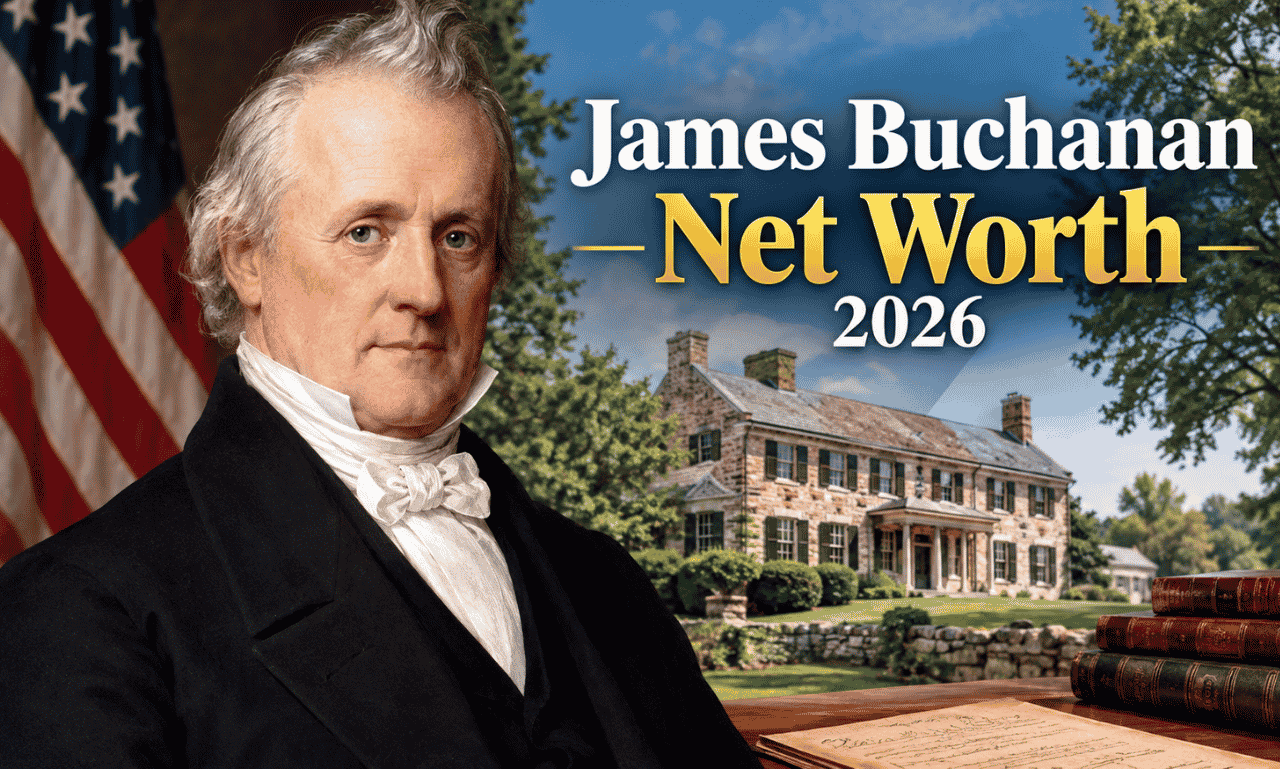
James Buchanan remains one of the most historically debated presidents in American history, but his financial story is often overlooked. As the 15th president of the United States, Buchanan spent decades building a career as a lawyer, politician, diplomat, senator, secretary of state, and eventually president. That long career also helped him accumulate considerable wealth for his era.
So, what was James Buchanan net worth?
Historical estimates vary because Buchanan lived in the 19th century, when financial records were not documented in the same way they are for modern public figures. Widely cited presidential wealth rankings place his peak fortune at less than $1 million when adjusted for inflation, while some biographical sources have estimated that his personal fortune was around $300,000. These figures should be treated as historical estimates rather than an exact audited net worth.
What is much easier to establish is how Buchanan built his fortune. His wealth came primarily from his successful legal career, investments in property, land ownership, public-service salaries, and decades of financial stability. His most famous property was Wheatland, his estate near Lancaster, Pennsylvania.
James Buchanan Net Worth
James Buchanan’s estimated net worth is generally placed below $1 million in historical presidential wealth rankings, although estimates vary depending on the valuation method used.
Unlike modern celebrities, Buchanan did not have a portfolio of entertainment contracts, endorsements, social-media income, or corporate businesses. His financial success came from the economic opportunities available to a prosperous American professional during the early and mid-19th century.
Buchanan was already financially successful before entering the White House. His legal practice in Lancaster became highly profitable, and he invested in real estate and other assets. The Miller Center notes that Buchanan had accumulated a substantial fortune at a relatively young age, reportedly exceeding $250,000 by the time he was around 30.
That early financial success is one of the most important facts when evaluating his net worth.
His presidency from 1857 to 1861 did not create his fortune. Instead, Buchanan entered the presidency as an already wealthy and established professional.
The frequently cited presidential wealth figure of less than $1 million should also be understood in historical context. A dollar in Buchanan’s lifetime did not have the same purchasing power as a dollar today. Researchers therefore use different methods to compare historical fortunes, which explains why different publications sometimes provide different estimates.
You must be read: Evanna Lynch Net Worth 2026: The Surprising Wealth Story
Why Buchanan’s Net Worth Is Difficult to Calculate
There is no single financial statement that establishes Buchanan’s exact net worth.
Historical estimates can differ because researchers may calculate:
- Wealth at the time of death
- Peak lifetime wealth
- Property values
- Investment holdings
- Inflation-adjusted purchasing power
- Estimated estate value
- Assets minus liabilities
For that reason, it is more accurate to describe Buchanan as having been financially wealthy but not among America’s richest presidents.
How James Buchanan Made His Money
Buchanan’s financial story is particularly interesting because it was largely established outside the presidency.
Legal Career
The foundation of Buchanan’s wealth was his legal career.
After graduating from Dickinson College in 1809, Buchanan studied law and was admitted to the Pennsylvania bar. He established his practice in Lancaster and eventually became one of the area’s successful attorneys.
His legal work provided an income that was considerably more substantial than the salaries available in many other professions at the time. Buchanan handled legal disputes and developed a strong professional reputation, allowing him to accumulate wealth before his national political career reached its height.
His success as a lawyer also gave him financial independence.
That independence was important because Buchanan spent much of his later life in government positions that limited opportunities for private professional work.
Real Estate and Property
Real estate represented another important component of Buchanan’s financial position.
In 1848, Buchanan purchased Wheatland, a large estate near Lancaster, Pennsylvania. The property originally covered roughly 22.5 acres and became his permanent home.
Buchanan reportedly paid $6,750 for the estate.
For Buchanan, Wheatland was more than a prestigious residence. It represented the type of tangible property that was an important part of wealth during the 19th century.
He later lived there after completing his presidency and returned to the property following his retirement from public life.
Investments
Buchanan also invested in land and buildings.
Unlike modern investors who may hold stocks, exchange-traded funds, cryptocurrency, and corporate shares, wealthy Americans in Buchanan’s era often placed substantial amounts of their capital into physical property.
His investments therefore need to be considered when examining his overall financial position.
Government Salaries
Buchanan held numerous government positions during his career, including seats in Congress, diplomatic appointments, secretary of state, and president.
The presidential salary during Buchanan’s administration was $25,000 per year.
He served one four-year term from March 4, 1857, to March 4, 1861. That means his nominal presidential salary over the full term was approximately $100,000 before expenses.
However, it would be misleading to suggest that the presidency was responsible for most of Buchanan’s wealth.
He was already a wealthy lawyer and investor before entering the White House.
Early Life and Education
James Buchanan Jr. was born on April 23, 1791, near Cove Gap, Pennsylvania.
His father, James Buchanan Sr., was an Irish immigrant who became a successful merchant. Buchanan grew up as the eldest son in a large family.
His family’s financial circumstances allowed him to receive a strong education.
Buchanan attended Dickinson College in Carlisle, Pennsylvania, and graduated in 1809. He subsequently studied law and established himself professionally in Lancaster.
His education had a major impact on his future career.
The combination of legal training, political ambition, and financial discipline eventually allowed Buchanan to become one of the most prominent Pennsylvanians of his generation.
James Buchanan’s Career Journey
Buchanan’s career was unusually long and diverse.
1809–1812: Legal Training
After graduating from Dickinson College, Buchanan studied law and entered the legal profession.
1812–1821: Early Political Career
Buchanan became involved in Pennsylvania politics while continuing to develop his legal career. He served in the Pennsylvania legislature and became increasingly prominent.
1821–1831: U.S. House of Representatives
Buchanan was elected to the U.S. House of Representatives and served for approximately a decade.
His experience in Congress strengthened his reputation as a serious national politician.
1832–1834: Diplomat to Russia
President Andrew Jackson appointed Buchanan as the U.S. minister to Russia.
The diplomatic appointment demonstrated the level of trust Buchanan had earned within the Democratic political establishment.
1834–1845: U.S. Senate
Buchanan returned to the United States and became a senator representing Pennsylvania.
His Senate career gave him greater national influence and helped establish him as one of the Democratic Party’s leading statesmen.
1845–1849: Secretary of State
President James K. Polk appointed Buchanan secretary of state.
During this period, Buchanan was involved in important diplomatic matters, including negotiations connected to the Oregon boundary and U.S. relations with Britain.
1848: Wheatland Purchase
Buchanan purchased Wheatland near Lancaster.
The estate became one of the most recognizable parts of his personal story and remained his home for the rest of his life.
1853–1856: Minister to Great Britain
President Franklin Pierce appointed Buchanan as the American minister to Great Britain.
His diplomatic experience made him one of the most internationally experienced politicians of his era.
1857–1861: President of the United States
Buchanan won the 1856 presidential election and became the nation’s 15th president.
His administration faced an increasingly severe national crisis over slavery, sectionalism, the Dred Scott decision, Kansas and the growing threat of secession.
1861–1868: Retirement
After Abraham Lincoln was inaugurated in March 1861, Buchanan returned to Wheatland.
He remained there for the remainder of his life and died on June 1, 1868.
James Buchanan’s Presidential Salary
Buchanan’s presidential compensation provides useful context for understanding his finances.
During his presidency, the annual presidential salary was $25,000.
Compared with modern presidential compensation, the amount may appear small, but its purchasing power was substantial in the 19th century.
Buchanan served for four years, meaning that his gross presidential salary was approximately $100,000.
Still, his personal fortune did not originate primarily from his White House salary.
His wealth had already been built through law, property, and investments.
This distinction is important because many modern net-worth articles incorrectly imply that presidential wealth is primarily generated by holding the office. For Buchanan, the opposite was closer to reality: his private fortune preceded his presidency.
Wheatland: Buchanan’s Most Famous Asset
Wheatland is perhaps the most important physical asset associated with James Buchanan.
Located near Lancaster, Pennsylvania, the estate became Buchanan’s home after he purchased it in 1848.
The property originally covered about 22.5 acres and included a mansion and supporting structures.
Buchanan spent much of his retirement at Wheatland, and it became closely associated with his legacy.
Today, Wheatland is preserved as an important historical site. Its significance goes beyond architecture because it provides insight into Buchanan’s lifestyle, family relationships, political career, and financial position.
For anyone researching James Buchanan net worth, Wheatland is an important part of the story because property ownership was a major component of 19th-century wealth.
You must be read: Fiona Shaw Net Worth 2026: Remarkable Career & Wealth Story
Personal Life and Harriet Lane
James Buchanan was never married.
He remains the only U.S. president who never married.
Buchanan had been engaged to Ann Coleman, a wealthy Pennsylvania woman, but the relationship ended tragically when Coleman died in 1819.
Buchanan never married afterward.
His niece, Harriet Lane, became an important member of his household. When Buchanan became president, Lane served as the White House hostess and performed many of the social duties normally associated with a first lady.
Harriet Lane later became an important figure in her own right and was closely associated with Buchanan throughout his public life.
Buchanan’s unmarried status makes his personal and financial story unusual compared with other presidents.
He did not build a traditional nuclear family household and instead maintained strong relationships with relatives, including Harriet Lane.
James Buchanan Net Worth Growth Timeline
| Period | Financial Development |
| 1791 | Born into a successful Pennsylvania merchant family |
| 1809 | Graduated from Dickinson College |
| Early 1810s | Began legal career |
| Around age 30 | Reportedly accumulated more than $250,000 |
| 1820s | Continued successful legal and political career |
| 1830s | Served as diplomat and senator |
| 1840s | Continued investing and building political influence |
| 1848 | Purchased Wheatland for $6,750 |
| 1845–1849 | Served as secretary of state |
| 1853–1856 | Served as minister to Great Britain |
| 1857–1861 | Served as president with $25,000 annual salary |
| 1861 | Returned to Wheatland |
| 1866 | Published a defense of his presidential administration |
| 1868 | Died at Wheatland |
How Wealthy Was Buchanan Compared With Other Presidents?
Buchanan was certainly wealthy by the standards of his time, but he was not one of the richest American presidents.
Presidential wealth rankings generally place him toward the lower end of the historical list.
That may initially seem surprising because Buchanan was already worth a significant amount before becoming president.
The reason is that several American presidents possessed extraordinary fortunes.
George Washington, for example, accumulated extensive wealth through land and plantation ownership. Thomas Jefferson owned substantial property, while later presidents such as Theodore Roosevelt, Franklin D. Roosevelt and John F. Kennedy came from prominent wealthy families.
Buchanan’s fortune was much more modest by comparison.
His wealth was better described as professional prosperity rather than extreme inherited or industrial wealth.
Major Achievements
Buchanan’s career included several notable accomplishments:
- Graduated from Dickinson College
- Became a successful Pennsylvania attorney
- Served in the Pennsylvania legislature
- Served in the U.S. House of Representatives
- Served in the U.S. Senate
- Became U.S. minister to Russia
- Served as secretary of state
- Served as U.S. minister to Great Britain
- Became the 15th president of the United States
- Purchased and developed Wheatland
- Became the only unmarried U.S. president
However, Buchanan’s historical reputation is strongly influenced by the failures of his presidency.
His administration struggled to manage the escalating conflict between the Northern and Southern states. The secession crisis began during the final months of his presidency, and Buchanan’s handling of the situation remains heavily debated by historians.
Did Buchanan’s Presidency Increase His Wealth?
Probably not to the extent that modern readers might assume.
Buchanan entered the White House with an established fortune.
His presidential salary added to his income, but the four-year period was relatively short compared with the decades he spent building his legal and investment wealth.
His wealth should therefore be understood as the result of long-term accumulation, not a sudden increase caused by becoming president.
This is one of the key differences between Buchanan and modern celebrities whose net worth can rise rapidly through a successful movie, album, business sale, endorsement agreement, or social-media career.
You must be read: Francesca Annis Net Worth 2026: Remarkable Career & Wealth
Interesting Facts About James Buchanan
- Buchanan was the 15th president of the United States.
- He served immediately before Abraham Lincoln.
- He was the only U.S. president who never married.
- His niece Harriet Lane served as White House hostess.
- He graduated from Dickinson College in 1809.
- He became a successful lawyer before entering national politics.
- He served as a U.S. diplomat in both Russia and Great Britain.
- He served as secretary of state under President James K. Polk.
- He purchased Wheatland in 1848.
- He retired to Wheatland after leaving the presidency.
- He died in 1868 at the age of 77.
- His financial success was established well before his presidency.
FAQs About James Buchanan Net Worth
What was James Buchanan’s net worth?
James Buchanan’s historical net worth is difficult to establish precisely. Major presidential wealth rankings generally place his peak fortune below $1 million when adjusted for inflation, while some biographical estimates put his wealth at approximately $300,000.
How did James Buchanan make his money?
Buchanan primarily made his money through his legal career, property ownership, land and building investments, and decades of professional and public service.
Was James Buchanan born wealthy?
Buchanan was born into a relatively successful merchant family in Pennsylvania. However, he developed much of his personal wealth through his own legal career and investments.
What was James Buchanan’s salary as president?
The presidential salary during Buchanan’s administration was $25,000 per year. He served one four-year term.
Did James Buchanan own Wheatland?
Yes. Buchanan purchased Wheatland near Lancaster, Pennsylvania, in 1848 for $6,750. The estate became his lifelong home.
Was James Buchanan married?
No. Buchanan never married and remains the only unmarried president in U.S. history.
Who was Harriet Lane?
Harriet Lane was Buchanan’s niece. She lived with him and served as his White House hostess during his presidency.
Was James Buchanan one of the richest presidents?
No. Although Buchanan was personally wealthy, historical presidential rankings generally place him near the lower end of the wealth spectrum.
What happened to Buchanan after his presidency?
Buchanan returned to Wheatland after Abraham Lincoln became president in 1861. He remained there until his death in 1868.
Why do sources give different James Buchanan net worth figures?
Historical financial records are incomplete, and researchers use different valuation methods. Some calculate peak wealth, while others focus on wealth at death or inflation-adjusted purchasing power.
Did Buchanan make money from his presidency?
His presidency provided a $25,000 annual salary, but most of his wealth had already been accumulated through his legal career and investments.
What was Buchanan’s biggest known asset?
Wheatland was his best-known property. The estate became his permanent residence and remains an important historical site.
Final Thoughts on James Buchanan’s Wealth
The story behind James Buchanan net worth is more complicated—and more interesting—than a single number.
Buchanan was not an extraordinarily rich president, but he was financially successful by the standards of his era. His fortune was built over decades through a profitable legal practice, property ownership, investments, and a long professional career.
His financial independence was already established before he reached the White House. By the time he became president in 1857, Buchanan had spent decades working as a lawyer, congressman, senator, diplomat, and cabinet official.
His purchase of Wheatland in 1848 provides one of the clearest examples of his financial position. The property became his home, retirement residence, and one of the enduring physical symbols of his life.
The commonly cited estimate of less than $1 million should therefore be viewed as a historical comparison rather than a precise bank-account figure. Other estimates, including figures around $300,000, reflect different ways of calculating wealth in an era when detailed personal financial records were uncommon.
The bigger takeaway is that Buchanan’s wealth came from professional success and long-term asset accumulation, not from the presidency itself.
For that reason, the most accurate description of James Buchanan’s financial legacy is that he was a wealthy 19th-century lawyer and statesman whose fortune was substantial but comparatively modest among U.S. presidents.
You must be read: Frank Dillane Net Worth 2026: His Remarkable Rise to $2 million and $4 million